
 Polski
 English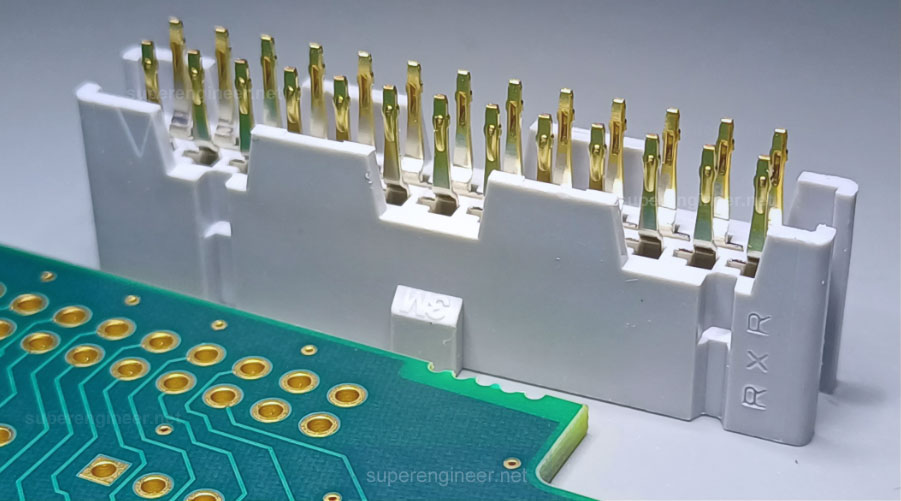
Introduction
Gold is commonly considered a premier material in the electronics industry, associated with high reliability and superior quality in mission-critical applications. This is because gold is a noble metal, it does not oxidize or "corrode". In other words, it simply does not react with most common chemicals.
Of course, there are chemical compounds that do react with gold, such as aqua regia (a mixture of acids), cyanides, mercury, and some halides. However, these substances are very rarely encountered under typical operating conditions.
Gold is therefore successfully used as a finish for PCB pads (so-called ENIG and ENEPIG), as well as a finish for edge connectors and pins of connectors. Gold provides excellent electrical contact and protects the base material of connector pins from corrosion.
However, gold does come with a certain problem. I am not referring to the cost of the raw material itself, which, as is well known, has been hitting record highs on global markets in 2025-2026. There is another, a less known but in some applications a very important issue - the impact of gold on brittleness of soldered joints.
Gold Embrittlement of Soldered Joints
During soldering of pins and PCB pads coated with gold, this element mixes with the molten solder. It migrates into the solder joint and forms so-called gold-tin intermetallic phases within the alloy[1]. Unfortunately, these intermetallics increase the brittleness of the solder joint, especially when there is a significant amount of gold in the area or when the soldering process is short enough that the gold has not fully mixed with the solder, resulting in localized high concentrations.
Brittleness can occur when soldering pins with very thick gold plating, typically above 2.54 µm [100 µin], or when the amount of solder is very small compared to the gold-plated surface, e.g., when using tiny gold-plated SMD components on gold-plated pads (such as ENIG).
In the electronics industry, it is generally considered that gold content near 3% (or more), will produce gold intermetallics that will significantly increase the joint's brittleness. This is referred to as gold embrittlement. Shocks, vibrations, and temperature changes can then cause the solder joint to crack.[1,2]
What to Do, How to Proceed…
In general, this issue occurs very rarely, as most components typically contain ratrher small amounts of gold :) However, in high-reliability applications, it may turn out, that components with a thicker gold plating are used. Ensuring high quality, particularly in IPC Class 2 and 3 products, is based on minimizing the amount of gold in the solder connection. How is it achieved?
The J-STD-001 standard defines requirements - when the gold removal procedure shall be implemented.[3]
Gold removal involves tinning the gold-plated area that will be used for a solder connection. After the tinning, the solder that has mixed with the gold shall be removed. By default, PCB coatings such as ENIG, NiPdAu, and ENEPIG are exempt from the gold removal requirement.[3]
It is also worth noting that the requirement to remove gold from solderable connector leads is addressed in IPC/WHMA-A-620 "Requirements for Cable and Wire Harness Assemblies".
Summary
Gold is a widely used element in electronics due to its resistance to oxidation and corrosion. However, if the gold content in a solder joint rises to around 3-4%, it negatively affects reliability by increasing the susceptibility to gold embrittlement.
According to J-STD-001 and IPC/WHMA-A-620 standards, excess gold shall be removed from areas reqired to be soldered (part of terminals) before final soldering. This is particularly important in applications where high reliability under harsh operating conditions is critical. Refer to J-STD-001 and/or IPC/WHMA-A-620 for more details.
References
- IPC-AJ-820A, Assembly and Joining Handbook, Rev. A, IPC, Bannockburn, IL, USA, 2012.
- IPC-HDBK-001, Handbook and Guide to Supplement J-STD-001, Rev. F, IPC, Bannockburn, IL, USA, 2016.
- J-STD-001, Requirements for Soldered Electrical and Electronic Assemblies, Rev. J, IPC, Bannockburn, IL, USA, 2024.
