
 Polski
 English
Introduction
The control chart used within the framework of SPC (Statistical Process Control) is a great tool that allows distinguishing between common causes (natural, inherent fluctuations) and special causes (excessive changes, failures, or issues) in a monitored process. In other words, a control chart helps to control a process by indicating when it is relay necessary to intervene (adjust process) and when it is better to relax (and have a good cup of coffee :) and calmly observe the process.
As part of this concept, statisticians have developed various rules (sometimes referred to as tests) used to detect these unwanted special causes.
The foundations for these rules were established by W.A. Shewhart, and were later expanded by the Western Electric Company[1]. Another, well-known set of rules is the so-called Nelson Rules - it is the main topic of this article.
A Bit of History
- 1926. Walter A. Shewhart developed the concept of control charts and the idea of distinguishing between common and special causes (he published this idea in 1931). Exceeding a control limit is a typical example of a special cause.
- 1956. The Western Electric Company published the "Statistical Quality Control Handbook", which formally defined four rules for control charts, known as the Western Electric Rules.
- 1984. Lloyd S. Nelson published the article "The Shewhart Control Chart - Tests for Special Causes"[1], in which he proposed a set of eight rules expanding on the earlier approach, now known as the Nelson Rules.
Nelson Rules
Lloyd S. Nelson was an American statistician (1918-2013) who developed eight rules designed to easily detect the occurrence of special causes in a process monitored using SPC control charts. These rules are now referred to as the Nelson Rules or Nelson Tests.
The developed rules apply to X-bar (average) charts as well as individual (X) charts, and assuming a normal distribution of data.
The area of the control chart is divided into six zones of equal height. Three on each side of the process centerline. For a normally distributed process, these zones correspond to multiples of the standard deviation σ, as follows:
- Zone A - between 3σ and 2σ from the centerline.
- Zone B - between 2σ and 1σ from the centerline.
- Zone C - between 1σ and the centerline.
Nelson proposed[1] the following set of rules:
Rule 1
One point beyond Zone A. In other words - a single data point lies beyond three standard deviations from the mean, that is, outside the control limit. This is the most obvious "out of control" situation.

Rule 2
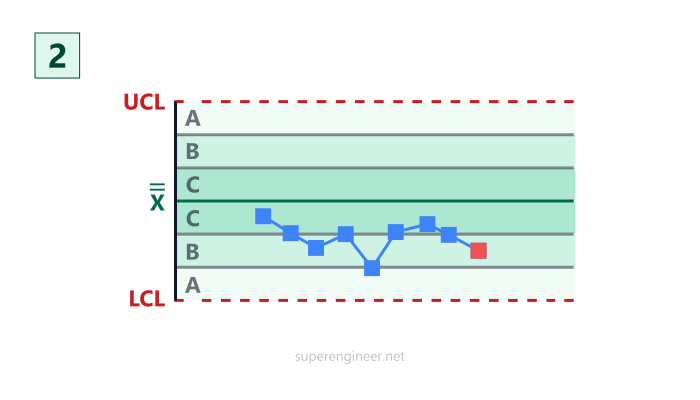
Nine points in a row in Zone C or beyond. If nine consecutive points fall on the same side of the mean (either above or below), it indicates a prolonged deviation or trend.
Rule 3
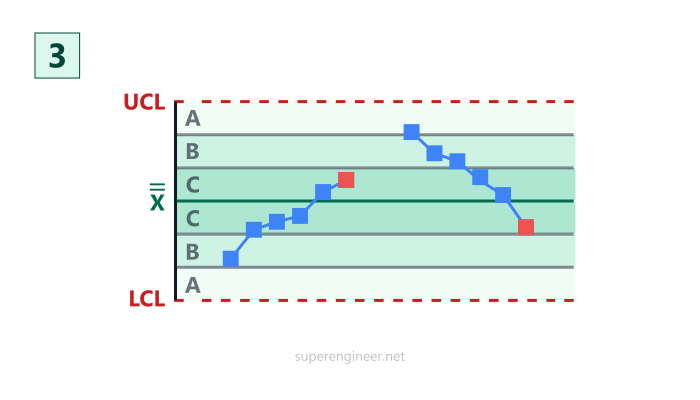
Six points in a row steadily increasing or decreasing. The appearance of an upward or downward trend may indicate, for example, tool wear or a gradual decline in reaction efficiency in chemical processes, etc.
Rule 4
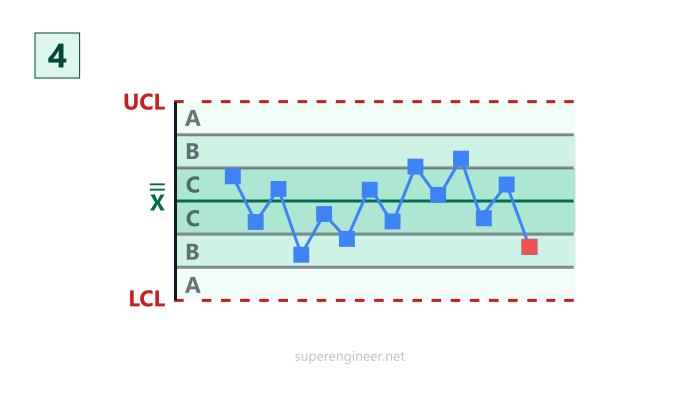
Fourteen points in a row alternating up and down. This indicates disturbances greater than "random process noise", for example, an overly sensitive control system, an operator making adjustments each time, or oscillations/vibrations, etc.
Rule 5
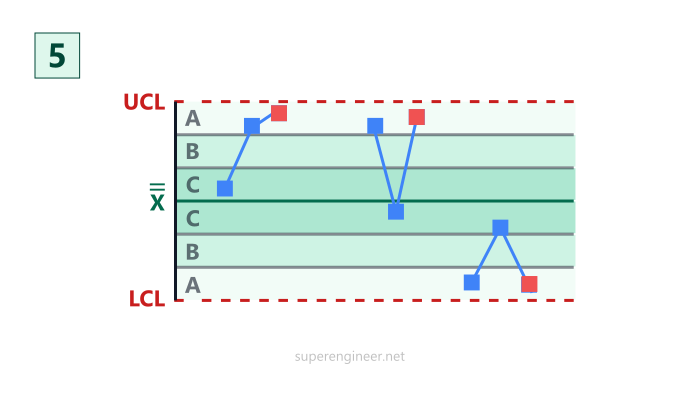
Two out of three points in a row in Zone A or beyond. In other words - two out of three consecutive points are more than two standard deviations from the mean in the same direction. This indicates a tendency for the process to drift out of control, for example, slight contamination in the material or local variations in material hardness, etc.
Rule 6
Four out of five points in a row in Zone B or beyond. A possible process drift - four out of five consecutive points are more than one standard deviation from the mean in the same direction. Example causes include a change in material batch or deformation of the nozzle feeding the material, etc.

Rule 7
Fifteen points in a row in Zone C (above and below centerline). The process appears too stable (too perfect) - variability remains within ± one standard deviation on both sides of the mean. This may indicate, for example, selecting only the best samples for SPC analysis :), a problem with the measurement system, or something positive such as an implemented process improvement.

Rule 8
Eight points in a row on both sides of centerline with none in Zones C. If eight consecutive results "oscillate" — jumping between the upper and lower parts of the chart, this type of special cause is quite unusual. It may indicate, for example, testing samples coming from two different processes, different machines, or production cells, etc.

Summary
The Nelson Rules are a useful tool for identifying special causes, especially when using software for SPC control charts. However, it is important to remember that enabling all the rules (tests) simultaneously may lead to numerous false alarms. This is particularly significant for highly capable processes, where Cp, Cpk and Pp, Ppk indices are high. Reacting to such false alarms can actually cause the process to become unstable.
Using such tools is very helpful, but they should be applied with understanding. It is also important to remember that not every change in a process is a problem. For example, reducing variation or shifting the process mean in the desired direction will also be detected by the Nelson Rules as special causes, even though these are intentional process improvements.
In summary, data and any alarms resulting from the Nelson Rules should always be interpreted with an understanding of the technical aspects of the given process and a basic knowledge of statistics. Critical thinking should always be applied when analyzing results.
Finally... the truth is, critical thinking should always be applied :)
References
- Lloyd S. Nelson, "The Shewhart Control Chart - Tests for Special Causes", Journal of Quality Technology, vol. 16, no. 4, 1984.
